Location without addresses
There’s a kind of image that unsettles you before you understand why.
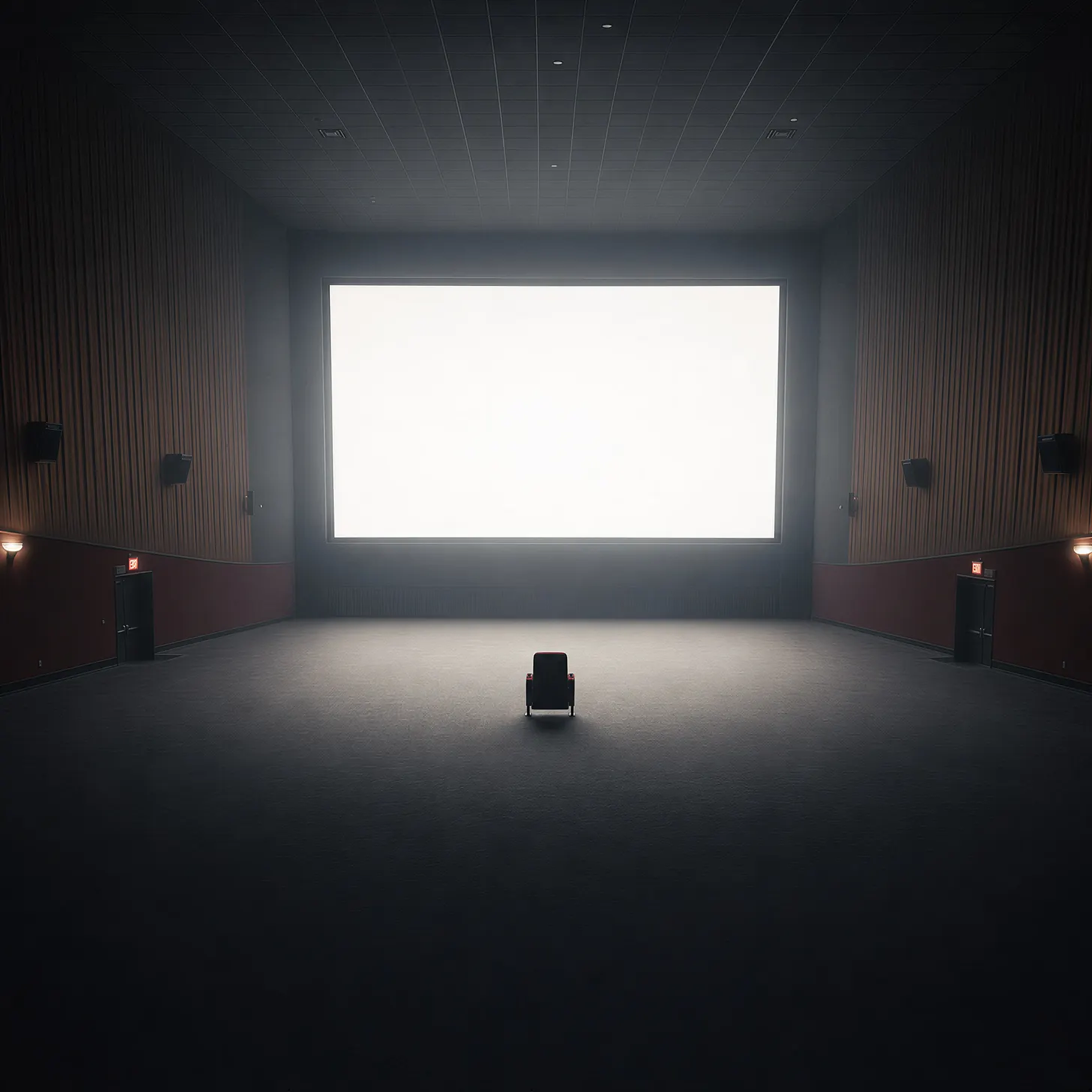
An empty hotel corridor at 3 a.m. A parking garage with no cars. A shopping mall after closing, fluorescent lights still on, nobody inside. These are liminal spaces, places that exist only as transitions, between here and there, between one state and another. You’re not supposed to stay in them. You’re supposed to pass through, and the unease you feel when you linger is the space itself reminding you that it was never meant to be inhabited.
The internet became obsessed with them a few years ago. Thousands of photos of empty pools, abandoned lobbies, backrooms that feel like a dream you can’t quite place. The fascination wasn’t aesthetic, it was psychological. These images triggered something: a recognition without memory, a familiarity with no source.
I think about this constantly since I started working with AI, because AI doesn’t just reproduce liminal spaces. It is one.
Every image I generate exists in an in-between. It looks like a photograph but was never taken. It shows a face that belongs to no one, a room that has no address, no architect, no history. The light is plausible, the texture is convincing, and underneath all of it, nothing. No moment. No place. No witness.
I spent hours selecting images for Nocturne, my first AI campaign, choosing this face over that one, this rooftop over that desert, this expression over this other one that was almost right but not quite. Some of them were genuinely beautiful, and I responded to them the same way I’ve responded to real images for 25 years, something in the eye firing, something in the gut confirming. But there was always this thin layer of wrongness underneath, not in the pixels, not in any technical flaw you could point to, but in the feeling itself. As if something in the image knew it hadn’t happened.
That’s the liminal quality. Not ugly, not broken — just between. Between real and unreal, between memory and fabrication, between something and nothing.
Baudrillard[1] wrote about this decades ago: the simulacrum, the copy without an original, the image that no longer refers to any reality but simply refers to itself. He was writing about advertising and media, but AI takes his argument somewhere he couldn’t have anticipated. We’re no longer copying reality or even constructing a flattering version of it, we’re generating a parallel version that was never anchored to reality in the first place.
A photograph, even a heavily manipulated one, starts somewhere real. Someone stood in a place, light fell on a surface, a shutter opened and closed. There is a before and after, a trace of something that existed. An AI image has none of that history. It arrives fully formed from a statistical latent field, a probability made visible, and because there was nothing to remember, there is no memory in it.
And yet, it might move you.
That’s the question I keep returning to, and I don’t have an answer to it: if there’s no real moment behind the image, no place, no light, no witness, no accident that could only have happened once , what exactly is the eye responding to? Is there something in the composition, in the arrangement of tones and forms, that carries emotional weight regardless of its origin? Has the image always been, at some level, a representation that operates independently of the reality it claims to show?
What I notice is that the images that moved me most during Nocturne were almost always the ones that felt the most liminal, not too perfect, not too broken, sitting right on the edge of plausibility. The ones that gave me that corridor feeling: you’ve been here before, but you haven’t, and the gap between those two things is where the image lives.
My eye still knows. What I can’t tell you is what it was choosing from, because the usual answer: truth, presence, the irreducible fact of a moment that happened, doesn’t apply here. Something else is doing the work, and I’m not sure I understand it yet. There’s something almost narcotic about working in a space that obeys different rules. This is a strange freedom in a world where the light does what you imagined rather than what it was, where the face holds the expression you needed, not the one the person could sustain. It’s genuinely seductive, and I’m genuinely suspicious of that seduction, because liminal spaces are not meant to be inhabited. They’re passages, and if you stay in them too long, the comfort tips into disorientation.
I already see this in some AI work: entire visual universes that feel complete on the surface and hollow one layer down, worlds that have learned the grammar of emotion without having anything to say with it. The uncanny valley isn’t just about faces anymore, it’s about worlds. The challenge, for someone coming from years of practice, isn’t to make AI images that pass for real. It’s to make something that knows what it is, that uses the in-between honestly rather than trying to paper over it.
Maybe that’s where the new visual language actually lives, not in simulation, not in replication, but in the threshold itself. In images that are honest about their nature: things that were never seen, only imagined, then made visible through a process no one fully understands yet. The first photographers were accused of stealing souls. The first filmmakers were told their images were lies. Every new image-making technology has passed through this corridor of suspicion, this liminal moment where we don’t yet know what it is or what it means.
AI is in that corridor now. And so am I.
Simulacres et simulation - Jean Baudrillard ↩︎